

Credit Card Refinancing
There is a lot to save on refinancing and consolidating credit card debt.
Credit Card Refinancing
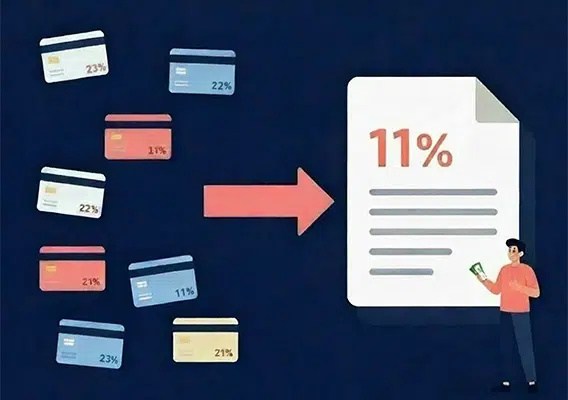
Credit card debt is the most expensive type of debt most people have. By refinancing, you consolidate all your credit card debt into a single loan with a lower interest rate, one due date, and one fixed repayment schedule. For many people, this means several thousand kroner less in monthly expenses.
At Eiendomsfinans, we’re a financial advisor. That means we don’t sell a single bank’s product, but instead review your financial situation and obtain offers from several of the banks we partner with—both secured and unsecured loans. You’ll be assigned a dedicated advisor who will guide you through the process from start to finish.
We also take on cases that others turn down. If you have a payment delinquency, a high debt-to-income ratio, or have been turned down by your bank, there are still solutions to consider.
Your Safety
- Registered financial agent with the Financial Supervisory Authority
- Free and with no obligation
- 8 branches in Norway
Why is it worth refinancing credit card debt?
The reason is simply the difference in interest rates. The Debt Register measures the actual interest burden on unsecured debt in Norway, and the difference between credit cards and installment loans is significant:
Source: Gjeldsregisteret AS
|
Type of debt
|
Average Nominal Interest Rate
|
|---|---|
Specifically, you’ll get four benefits from refinancing:
- A lower interest rate. That’s the whole point. The difference between the short-term interest rate and the interest rate on a refinancing loan is money you keep for yourself.
- Fewer fees. Four cards mean four monthly installment fees. One loan means one.
- A fixed repayment plan. You know exactly when you’ll be debt-free, instead of paying a minimum amount with no end date.
- Overview. One invoice, one due date, one bank to deal with.
What does it mean to refinance a credit card?
Refinancing credit cards means taking out a new loan and using the money to pay off your credit card debt. The cards are paid off in full, and instead, you’re left with one loan, one interest rate, and one monthly payment.
In other words, you don’t get rid of your debt by refinancing—you just move it to a cheaper place. That’s exactly why it’s worth it: a refinancing loan has a lower interest rate than a credit card, and it has a fixed end date. A credit card only requires you to pay a minimum amount each month, and if you pay only that, the debt can remain outstanding for many years while interest continues to accrue.
It’s also common to include other high-interest debts in the same loan. If you have small loans, personal loans, or store credit accounts in addition to your credit cards, they should be evaluated together.
Three things you should be aware of:
A longer term may cost more overall
The cards should be canceled or restricted
Refinancing does not solve a spending problem
A lower monthly payment feels good, but if you spread your debt over several years, you’ll be paying interest for several years. We always show you both the monthly payment and the total cost, so you can make an informed decision.
If your credit limit remains at its full amount after refinancing, there’s a good chance that your debt will start to build up again. Then you’ll have two loans instead of one. Cancel the cards you don’t need, or lower the credit limit—you can often do this yourself through online banking. If you don’t cancel the card, it won’t be automatically blocked upon refinancing, unless you’re already in default on the payment.
Refinancing solves the interest problem, not the cause of the debt. If your expenses exceed your income, the debt will return. We’ll go over your budget with you as part of the assessment. If you need help beyond what we can provide, NAV offers free debt counseling, and in certain cases, the municipality may grant a starter loan for refinancing if you’re at risk of losing your home.
With or without collateral—two ways to lower your interest rate:
This is the choice that determines what interest rate you’ll end up with. If you can provide collateral, the loan will be cheaper. If you can’t, there’s still a solution:
—it just costs a little more.
Refinancing with security in housing
If you own a home with equity, this is by far the most affordable option. The bank takes a mortgage on the home and, in return, offers you an interest rate closer to that of a mortgage rather than a credit card.
The prerequisite is that there is room within 90% of the home’s value after subtracting the existing loan. The bank will normally require an online appraisal from a real estate agent that is no more than six months old. The easiest option is to refinance your existing mortgage, but your bank isn’t obligated to approve it—and that’s where we come in. We know which banks actually offer this type of financing.
Refinancing without collateral
If you don’t own a home, or if your home is fully mortgaged, you can refinance your credit cards with an unsecured loan. The interest rate will be higher than with a mortgage, but still significantly lower than on the cards.
A fact that few people know: The lending regulations normally set a five-year term limit for consumer loans, but that limit does not apply when the purpose is refinancing. This allows for a longer repayment period and a monthly payment you can afford. At the same time, a longer term increases the total cost—it’s a trade-off we’ll go over with you.
Refinancing is also viewed more favorably in the bank’s credit assessment than a typical consumer loan, because your total debt does not increase. You are replacing expensive debt with less expensive debt.
Second-priority loans when the bank says no
If you have available equity in your home but are denied the option to consolidate your credit card debt into your mortgage, there is an intermediate solution: a separate loan secured by your home at second priority. Your mortgage remains as is, and the credit card debt is transferred to a secured loan with a bank that specializes in this type of arrangement.
The interest rate is higher than on a standard mortgage, and the origination fee is often higher, but it’s usually well below both personal loans and credit cards. For many people, this is the solution that actually works out.
Security in Someone Else's Home – Guarantor
The bank may also take a mortgage on another person’s property. If your parents or close family members are willing to use their home or vacation home as collateral for you, you can obtain terms equivalent to a mortgage-backed loan even if you do not own a home yourself. This is a serious responsibility for the guarantor, and we go over what it entails for both parties before anything is signed.
Refinance credit card calculator
Enter the total amount of debt you currently have on your credit cards. Compare the monthly amount shown by the calculator with what you’re actually paying now—be sure to include your entire payment, not just the interest portion.
The interest rate on refinancing is set on an individual basis based on your financial situation. Our lowest nominal interest rate is 7.99% without collateral, and a realistic starting rate for most people is between 10 and 14%. The calculator provides an estimate, not an offer.
Lånebeløp
Antall år
Nominell rente (%)
Etableringsgebyr
Termingebyr
Per måned:
0 KrTotalbeløp
0
Kostnad
0
Etableringsgebyr
1500 Kr
Termingebyr
50 Kr
Effektiv rente
-
How We Work
Eiendomsfinans is a registered financial agent under the supervision of the Financial Supervisory Authority of Norway, and our advisors are FinAut-authorized.
We are not a bank, and we are not a search portal—we are the intermediary who knows the credit assessment criteria of each individual bank and knows where your application will actually be processed.

We have several offices in Norway, so you can meet us in person.
Fill out the application
It only takes a few minutes, and it’s completely free and with no obligation on your part. We receive a commission from the bank, and the loan won’t cost you any more just because you go through us.
We talk to the banks
You'll be assigned a dedicated advisor who will handle your case from the initial consultation through to payment. Your advisor will work with our partner banks to find the best solution for you at
.
Receive a non-binding offer
Once we’ve identified the solution we’re most confident in at
, we’ll contact you for a
no-obligation quote. We also handle cases that involve security concerns, have outstanding issues, or have been referred to a collection agency.
With us, you will be assigned a dedicated advisor who will help you every step of the way. After
a pleasant conversation with you, we map out your financial situation.
FAQ
- Frequently Asked Questions About Credit Card Refinancing
What does it mean to refinance a credit card?
What does it mean to refinance a credit card?
This means you take out a new loan and use it to pay off your credit card debt. The cards are paid off in full, and you’re left with one loan, one interest rate, and one due date instead of multiple cards with high interest rates.
How much can I refinance?
How much can I refinance?
You can refinance credit card debt of up to 800,000 kroner without collateral. If you need to refinance more than this amount, you must be able to provide real estate as collateral. In that case, you’ll also receive better terms, for example through a second-lien loan.
What is the longest repayment period I can get?
What is the longest repayment period I can get?
When refinancing credit card debt, you can get a term of up to 15 years. The normal five-year limit for consumer loans set by the Lending Regulations does not apply when the purpose is refinancing. Keep in mind that a longer repayment term results in lower monthly payments but a higher total cost.
Is it always worth it to refinance credit card debt?
Is it always worth it to refinance credit card debt?
Almost always, because credit card debt is among the most expensive types of debt there are. The exception is if you manage to pay off the entire balance on your card within a short period of time—in that case, little interest accrues, and refinancing is unnecessary. If the balance is large and repayment is slow, the savings are significant.
Can I refinance a credit card if I have a payment delinquency on my record?
Can I refinance a credit card if I have a payment delinquency on my record?
Yes, but that requires collateral—either your own home or a guarantor’s. This solution is called a “restart loan” and is offered by banks that specialize in such cases. Without collateral, it is very difficult to obtain refinancing if you have a credit blemish.
Will my credit card be blocked when I refinance?
Will my credit card be blocked when I refinance?
No, not automatically, provided the payment is not already in default. The card will still have available credit. We still recommend that you cancel any cards you don’t need or lower your credit limit so that debt doesn’t build up again.
How much does it cost to use Eiendomsfinans?
How much does it cost to use Eiendomsfinans?
Nothing. We are a financial broker and receive a commission from the bank where you may take out the loan. The loan will not cost you more just because you apply through us.
What documents do I need to apply?
What documents do I need to apply?
Your most recent pay stub, your most recent tax return, and a printout from the Debt Registry showing the unsecured debt you want to refinance. You can log in to the Debt Registry using BankID, and it’s free.
How long does it take to refinance?
How long does it take to refinance?
Unsecured refinancing can be completed in just a few days, since no appraisal or mortgage registration is required. If you plan to use your home as collateral, an electronic appraisal must be obtained and the mortgage registered, in which case you should expect the process to take a little longer.
How to Refinance Your Credit Card Debt – Step by Step:
|
Documents you should have ready: your most recent pay stub, your most recent tax return, and a printout from the Debt Registry.
|
|---|
Loan Example:
Unsecured refinancing
Loan of 215,000 kroner over 10 years, effective interest rate 12.73%, origination fee 2,495 kroner. Cost: 155,396 kroner. Total: 370,396 kroner.